There is no bad season in the Great Smoky Mountains, but fall has a way of making even longtime locals stop and stare.
It often begins subtly in the high country. Clusters of brilliant red-orange American mountain ash berries stand out against the green forest, cooler nights settle over the highest ridges, and the first leaves begin to turn. Morning fog drifts through the folds of the mountains, the air loses some of summer’s heaviness, and hints of gold, crimson, and orange begin appearing across the landscape.
Then the transformation gathers momentum.
With more than 140 species of trees, eight distinct forest types, and an incredible range of elevations and microclimates, autumn doesn’t simply arrive in the Smokies—it moves through them. Color begins high on the ridges and slowly spills downhill until entire mountainsides look painted in layers of scarlet, gold, copper, orange, and deep evergreen.
For us, it is one of our favorite times of year to hike and backpack in the Smokies.
And while the fall color is spectacular, what makes autumn here truly remarkable is the extraordinary living landscape creating it.
Why Fall Color in the Smokies Is So Extraordinary
The Great Smoky Mountains are home to more than 140 species of trees and eight distinct forest types, creating a diversity of fall color that is difficult to match almost anywhere else.
Maples flash brilliant red and orange. Hickories turn rich gold. Tulip poplars glow yellow across the lower slopes. Sourwoods deepen into scarlet. Oaks move more slowly, eventually covering the mountainsides in shades of russet, copper, burgundy, and brown.
And it doesn’t all happen at once.
The Smokies rise from roughly 800 feet to more than 6,600 feet in elevation, creating countless microclimates throughout the park. Temperature, moisture, elevation, slope direction, and forest type all influence when leaves begin to change.
That means autumn often arrives gradually, beginning on the highest peaks and working its way downhill over several weeks.
One day you may hike through peak color along a high ridge while the valleys below remain mostly green. A week or two later, those same lower elevations may be glowing.
It is one reason there is no single perfect “peak fall color” date in the Smokies. Fall unfolds across the landscape.
A Forest With the Diversity of a Continent
The biological richness of the Great Smoky Mountains is difficult to overstate.
Because of the park’s enormous range of elevations, rainfall, temperatures, soils, forests, and habitats, the Smokies contain an ecological diversity sometimes compared to traveling the length of the entire eastern seaboard.
Within a relatively small geographic area, you can move from lush cove hardwood forests of the Southern Appalachians to high-elevation spruce-fir forests that feel far more northern.
That diversity is one reason Great Smoky Mountains National Park has become one of the world’s great places to study biodiversity.
Through the All Taxa Biodiversity Inventory, researchers have documented an astonishing variety of life in the park, including more than 1,000 species previously unknown to science.
And new discoveries continue to be made.
So when you walk through the Smokies in autumn, you aren’t simply walking beneath colorful trees. You are moving through one of the richest temperate ecosystems on Earth.

Autumn Has Been Important Here for Thousands of Years
Fall in these mountains also carries a much older meaning.
For the Cherokee people, whose ancestral homeland includes the Great Smoky Mountains and the surrounding Southern Appalachians, the seasons have long been closely connected with the cycles of plants, animals, food gathering, ceremony, and community.
In Cherokee tradition, the arrival of autumn is marked by Duli̱sdi (ᏚᎵᏍᏗ), the Nut Moon, representing an important season of harvest, gratitude, and preparation before winter.
September is known as Duli̱sdi, signaling the season when foods including hickory nuts, walnuts, chestnuts, and acorns drop from the trees.
Long before visitors traveled to the Smokies to photograph fall foliage, people were reading these forests in a very different way—not simply for their beauty, but as sources of food, medicine, knowledge, ceremony, and connection to the land.
Remembering that history adds another layer to an autumn walk through these mountains.
Cooler Nights, Comfortable Days
There is another reason we love fall hiking in the Smoky Mountains:
It simply feels good outside.
After the heat and humidity of summer, cooler evenings begin returning to the mountains. Mornings can be crisp, while afternoons are often pleasantly mild.
Those cooler temperatures can make long hikes more comfortable, especially on trails with significant elevation gain.
Autumn backpacking can be even better.
There is something particularly satisfying about hiking all day through changing forests, reaching camp as the temperature begins to drop, pulling on a warm layer, eating dinner beneath the trees, and crawling into your sleeping bag on a cool mountain night.
The forest smells different in fall, too—drying leaves, damp earth, rich forest soil, and that unmistakable crispness in the air that tells you winter isn’t far away.

The Mountains Really Do Look Painted
Some autumn days in the Smokies hardly look real.
From a high overlook or an exposed ridge, layer after layer of mountains stretches toward the horizon, each ridge carrying a slightly different palette.
Bright yellow coves. Red maple slopes. Dark green spruce and hemlock. Copper oak ridges. Blue mountains fading into the distance.
Morning fog may fill the valleys while the peaks rise above it in sunlight. By late afternoon, low-angle light can make the entire landscape glow.
These are the days that remind us why generations of people have fallen in love with these mountains.


One of the Best Times to Explore on Foot
Fall is famous in the Smokies, which means certain roads, overlooks, and easily accessible destinations can become busy.
But one of the best things about hiking is how quickly the experience can change once you begin walking.
A trail may start near a crowded parking area and, within a mile or two, become surprisingly quiet.
Backpacking takes that experience even farther.
Instead of simply driving through fall color, you become part of it.
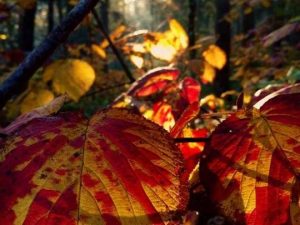
You hear leaves crunch beneath your boots. You watch them drifting through shafts of sunlight. You notice individual trees, berries, changing forests, and subtle shifts in elevation rather than seeing the mountains only from a roadside overlook.
And because autumn progresses differently at different elevations, almost every hike offers something unique.

Come Walk Through Fall With Us
After decades of hiking these mountains, fall still feels special to us.
Maybe it is the cooler nights.
Maybe it is spotting those first brilliant clusters of American mountain ash berries in the high country.
Maybe it is the anticipation of seeing where the color has reached that week.
Maybe it is knowing that beneath all that beauty lies an ecosystem containing thousands upon thousands of interconnected species—and stories stretching back far beyond the creation of the national park.
Or maybe it is simply the pleasure of putting on a pack, stepping onto a trail, and walking into a forest that seems to change color by the hour.
Whatever the reason, fall remains one of our favorite seasons to hike and backpack in the Great Smoky Mountains.
If you have always wanted to experience autumn beyond the scenic overlooks, join A Walk in the Woods for a guided day hike, backpacking trip, or Smokies adventure.
Let us help you leave the crowds behind, discover what is happening in the forest, and experience fall the way we think it is best experienced:
Walk into it.